Black Friday 2026 Affiliate Checklist: What to Check Before Scaling
Here are four checks worth completing before pushing more traffic into your Black Friday campaigns.
Black Friday 2026 is coming with the usual pressure: higher traffic costs, crowded auctions, bigger click volumes, and very little time to fix mistakes once campaigns are running.
For affiliates, the critical decisions happen before budgets increase. Offer conditions, tracking accuracy, traffic quality, and payout economics all need to hold up when volume grows. A campaign that looks profitable at $200 a day can behave very differently at $2,000.
Here are four checks worth completing before pushing more traffic into your Black Friday campaigns.
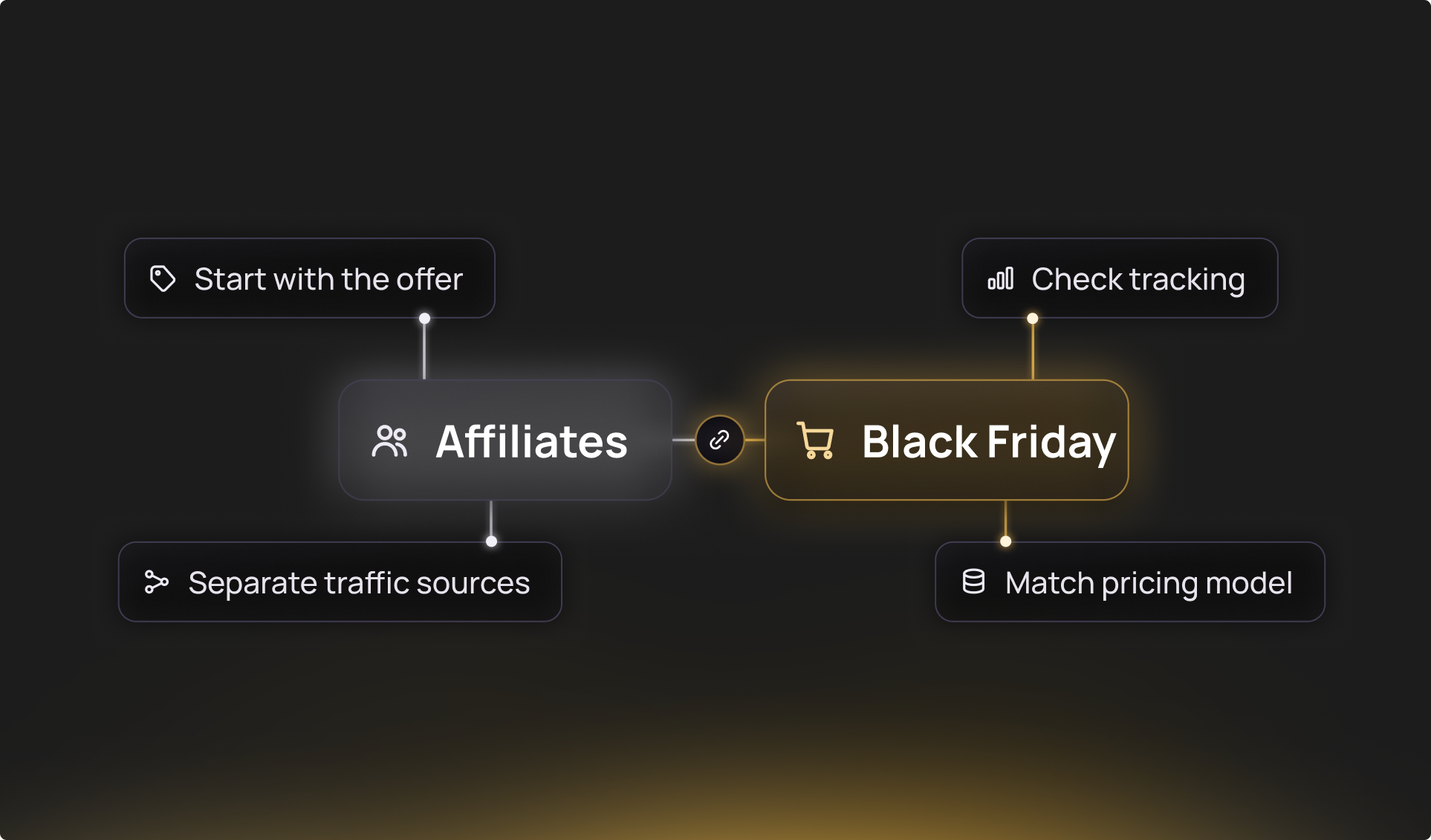
1. Start with the offer, before increasing traffic
A strong pre-season conversion rate is a useful starting point. Black Friday introduces several variables that can change the economics of an offer, including temporary discounts, shorter promotion windows, inventory restrictions, and increased competition for the same customers.
Before scaling, review the actual terms of each offer. Check whether commissions apply to discounted orders, which products qualify, and whether there are caps on conversions or daily volume. Confirm that promotional landing pages will remain active throughout the campaign and that discount codes work as advertised.
Pay particular attention to EPC (earnings per click) and approval rates. An offer with an attractive headline payout can become much less appealing when a large share of conversions is rejected or the average order value drops during a sale.
It also helps to have a backup offer ready in each priority vertical. If a merchant pauses a campaign, runs out of stock, or changes its terms, switching traffic should take minutes. The goal is to know exactly what happens to your margins as volume increases.
2. Check tracking before traffic gets expensive
Tracking errors become particularly costly during Black Friday. When campaigns are running across several platforms, even a small discrepancy can affect optimization decisions and attribution.
Start with a complete test conversion. Follow the entire path from ad click to landing page, affiliate redirect, merchant checkout, and recorded conversion. Confirm that click IDs and subIDs survive redirects and that the conversion appears under the correct campaign, creative, placement, and traffic source.
Pay special attention to these areas:
- Postbacks and conversion events. Verify that successful purchases trigger the correct event and that duplicate events are handled properly. Where supported, use server-to-server tracking to reduce dependence on browser-side signals.
- Attribution windows. Check the offer's cookie duration and conversion window. Black Friday shoppers often compare several deals before completing an order.
- Mobile and cross-browser journeys. Test links on actual mobile devices, including in-app browsers used by social platforms. Redirects and tracking parameters can behave differently outside a standard desktop browser.
- Revenue and conversion values. Make sure your tracker receives the correct payout amount, currency, and conversion status. A recorded purchase is only useful for optimization when the associated revenue is accurate.
- Reporting delays. Establish how quickly conversions appear and when pending transactions become approved. A delay of several hours can distort decisions during aggressive scaling.
Compare results across your traffic platform, affiliate tracker, and network dashboard. Some discrepancies are expected because platforms use different attribution methods. Large or unexplained gaps need investigation before additional budget goes live.
One useful precaution is to record a baseline before Black Friday begins: clicks, conversions, approval rate, EPC, and revenue by source. That gives you a reference point when performance changes during the sale.
Tracking should also be tested again whenever an offer switches to a special Black Friday landing page. A working evergreen link tells you very little about a newly introduced redirect.
3. Separate traffic sources before reading the results
A blended ROAS can make a campaign look healthier than it really is. One source may be generating profitable sales while another is consuming most of the budget with little return.
Black Friday makes these differences more noticeable because traffic sources respond to seasonal demand in different ways.
Google Search often captures shoppers who already know what they want. Meta and TikTok can generate interest earlier in the purchase journey, with results influenced heavily by creative and audience selection. Reddit traffic depends on context and community expectations. Native and push campaigns may deliver substantial click volume, but require closer attention to traffic quality. Email, creators, and SEO bring their own attribution patterns and conversion timelines.
These channels deserve separate reporting.
For paid traffic, compare spend, CPC, conversion rate, approved revenue, and ROAS by source. Break down the strongest campaigns further by GEO, device, placement, and creative. For organic and creator traffic, look at EPC, conversion quality, and attributed revenue alongside engagement.
One useful check is to compare click growth with approved conversion growth. If traffic doubles while approved sales barely move, investigate the source before increasing its budget again.
Also consider the role of each channel. A creator video may introduce a product days before a customer searches for it on Google. Last-click reporting can give most of the credit to search, even when the creator contributed to the purchase.
Keep those differences visible in your reports. Scaling decisions become much easier when you know which source is bringing profitable customers and which is simply bringing more visitors.
4. Match the pricing model to the conversion path
Black Friday can produce excellent click-through rates and still leave an affiliate with disappointing earnings. The payout model determines how much of that activity becomes revenue.
With CPA, the main question is how reliably traffic produces an approved action. A campaign paying a fixed amount per qualified purchase or signup needs enough completed, validated conversions to cover acquisition costs.
With CPS (cost per sale), commission depends on the purchase value. Seasonal discounts can affect average order value, so a higher conversion rate may be accompanied by a smaller commission per order.
With CPL (cost per lead), the initial conversion may happen quickly, but lead validation and quality requirements matter. A large volume of Black Friday signups can be less valuable when approval rates fall.
For affiliates buying traffic on a CPC or CPM basis, the calculation becomes especially important. The cost of acquiring visitors may rise during the holiday period while affiliate payouts remain fixed.
Consider a simple example:
Illustrative CPA campaign
- Cost per click: $0.80
- Approved conversion rate: 2%
- Cost per acquisition: $40
- Affiliate payout: $50
- Margin before other costs: 20%
At a $1.00 CPC, the same conversion rate produces a $50 acquisition cost, eliminating that margin.
That is why pricing models should be reviewed alongside actual conversion behavior. Check the approved conversion rate, effective payout, and maximum affordable acquisition cost before increasing spend.
The final scaling check
Once the offer, tracking, traffic sources, and payout economics are verified, scaling becomes a question of controlled expansion.
Increase budgets in stages and watch whether acquisition costs, conversion rates, and approval rates remain stable. Keep a record of the changes you make, especially when several campaigns are running simultaneously. That makes it easier to identify which adjustment affected performance.
Black Friday 2026 falls on November 27, followed by Cyber Monday on November 30. The weeks leading up to those dates are the right time to validate your setup, establish reliable benchmarks, and identify the campaigns worth expanding.
Black Friday gives affiliates access to a concentrated period of buying intent, with plenty of competition for that attention. The campaigns worth scaling are the ones with verified tracking, reliable offers, and economics that can withstand more expensive traffic.
A few hours spent checking attribution, approval rates, and source-level performance can save a substantial amount of budget during Cyber Week. Once those numbers are dependable, there is room to scale with confidence and make adjustments based on what customers are actually doing.