AI in Affiliate Marketing: What Actually Moves Results
The workflow moves faster. The direction behind it matters more.
AI is already part of how affiliate marketing operates. It shows up in content, in campaign setup, in analysis, and in testing. What matters now is how it changes the system around it — not just individual tasks.
The impact isn’t evenly distributed. Some parts of the workflow improve immediately. Others become harder to manage once everything speeds up.
Where AI actually improves the workflow
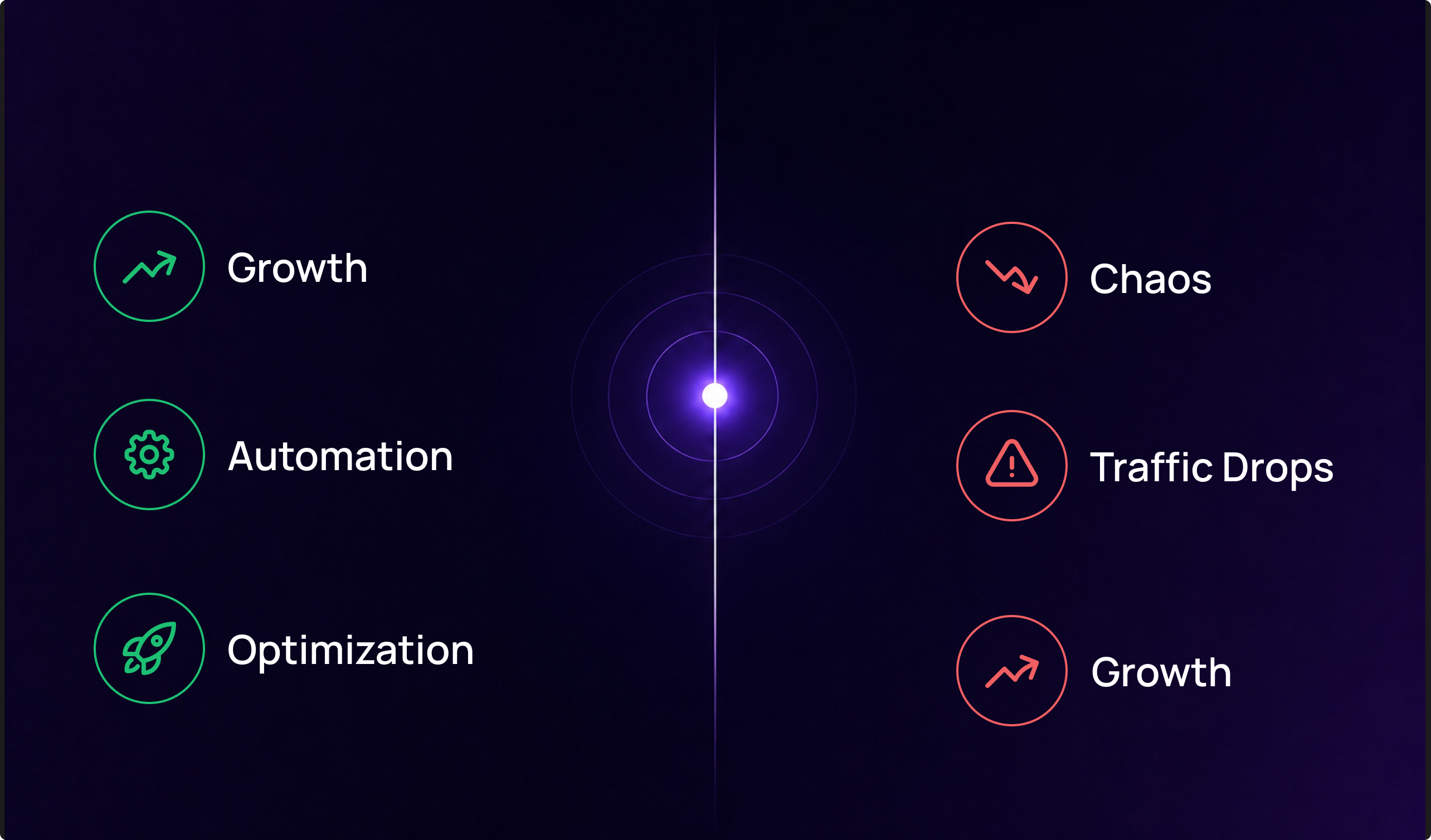
The most visible effect is speed. Campaigns move from idea to execution much faster than before. Drafts, pages, and variations no longer slow things down. That allows affiliates to test more angles and enter new niches without heavy setup.
This also changes how iteration works. Campaigns evolve while they are live. New variations can be introduced without resetting the whole process, which keeps momentum and shortens feedback loops.
Research follows the same pattern. AI organizes large datasets into usable structures — keywords, topics, clusters. Less time goes into gathering information. More attention goes into choosing what deserves to be built.
Where friction starts to appear
Speed increases competition. More affiliates can produce more content in less time, often targeting the same offers and queries.
The result is easy to spot: pages start to look similar. Structure is rarely the issue anymore. Most content is readable, formatted, and technically correct. That raises the baseline, but it also removes obvious differentiation.
At this point, performance depends on positioning. The angle, the specificity, and how closely a page matches intent become the deciding factors.
What changes in content performance
Content quality is more consistent across the board. There are fewer weak pages, but also fewer that stand out. A large share of content sits in the same range.
The pages that perform tend to narrow down the problem they solve. They speak to a конкрет scenario instead of covering a topic broadly. That clarity is what separates them in crowded results.
Timing becomes more important as well. Once a page or campaign starts working, similar versions appear quickly. Structures and ideas spread fast. The window to scale before saturation is shorter.
How affiliates actually use AI in practice
In working setups, AI rarely sits as a single step. It’s part of a loop.
A typical flow looks like this: generate structure → explore multiple angles → select one direction → refine it manually → launch several variations at once.
The value comes from compressing the cycle between idea and test. Not from publishing more pages, but from reaching a usable version faster and iterating on it.
Where most setups break
AI doesn’t introduce new mistakes. It amplifies existing ones.
Common patterns show up quickly:
- too much content built around weak angles
- tests launched without a clear hypothesis
- early signals treated as stable performance
- pages scaled without checking intent or retention
Because everything runs faster, these issues surface earlier — and at larger scale.
What separates stronger setups
At a basic level, AI is used to generate output. Stronger setups use it to guide decisions.
That includes:
- breaking down competitors to find gaps
- testing angles, not just formats
- focusing on intent before keywords
- filtering ideas instead of publishing all of them
The difference shows up in how much gets rejected before going live.
What changes in the economics
AI reduces the cost of production. Launching pages, testing ideas, and entering new niches takes less time and fewer resources.
Traffic, however, doesn’t get cheaper. That creates a shift: more content competes for the same attention. As a result, efficiency depends less on how much is produced and more on how well it converts.
Where AI requires more control
AI makes data easier to access and interpret, but it doesn’t replace judgment. Patterns appear faster, which can create false confidence in early results.
Campaigns that look strong at low volume often behave differently at scale. Without context, it’s easy to optimize toward signals that don’t hold.
Platforms are also adapting. Signals tied to usefulness, depth, and clarity become more important as content volume increases. Pages built only for coverage tend to lose visibility over time.
Final thoughts
AI increases speed, output, and access to data. It also removes many of the constraints that used to hide weak strategies. What remains is harder to automate: positioning, interpretation, and decision-making.
The workflow moves faster. The direction behind it matters more.